
Fiber Rings for Solar Farms

Building Resilient Fiber Ring Networks for Solar Farms with RuggedNet 10G Industrial Ethernet Switches
Modern solar farms are no longer passive power-generation assets. They are highly instrumented, data-driven environments where real-time monitoring, control, and security systems are essential to maximizing energy output and ensuring operational continuity. At the core of these systems is the network infrastructure—often spanning miles of outdoor terrain, exposed to harsh environmental conditions, and required to operate continuously without interruption.
In real-world solar deployments, traditional enterprise networking equipment quickly reaches its limits. Distance, environmental stress, and the need for fault tolerance demand a different class of solution: industrial-grade Ethernet networking designed for resilience.
This case study examines how a large photovoltaic (PV) solar farm deployed a fiber ring topology using Omnitron RuggedNet 10G managed industrial Ethernet switches to achieve high availability, long-distance connectivity, and fault-tolerant operation—without compromising performance or reliability.
Industry Context: Networking in Utility-Scale Solar Farms
From an engineering standpoint, solar farms present a unique combination of networking challenges:
- Distributed assets spread across large geographic areas
- Continuous streams of operational data from inverters, sensors, and controllers
- Surveillance systems requiring reliable, low-latency connectivity
- Outdoor installations subject to temperature extremes, dust, and vibration
- Mission-critical uptime requirements tied directly to energy production
Each solar panel string and inverter generates performance data that must be transmitted in real time to a centralized control system for analytics, fault detection, and optimization. Any network interruption can delay fault response, reduce efficiency, or impact security visibility.
As solar farms scale, copper-based Ethernet quickly becomes impractical due to distance limitations and susceptibility to electromagnetic interference. Fiber optics, combined with a resilient network architecture, become essential.
The Network Challenge
Designing for Distance, Reliability, and Redundancy
The solar operator in this case faced the challenge of building a large-scale fiber ring network capable of supporting both operational data and surveillance traffic across the entire facility.
Key technical requirements included:
- Ring protection and fast failover using Media Redundancy Protocol (MRP)
- Long-distance Ethernet extension via fiber optic cabling
- Power redundancy to ensure continuous operation during electrical disturbances
- Support for real-time operational and security data with minimal latency
In real-world deployments like this, a linear or star topology would introduce single points of failure. A fiber cut, switch failure, or power issue at one node could isolate large portions of the site—an unacceptable risk for mission-critical infrastructure.
Without a properly designed ring topology and industrial-grade switching, the network would be vulnerable to outages that directly impact energy production and site security.
The Omnitron Solution Architecture
Fiber Ring Networking with RuggedNet 10G Industrial Switches
To meet these requirements, the solar operator deployed Omnitron RuggedNet 10G/Mi managed industrial Ethernet switches as the backbone of a resilient fiber ring network.
Rather than relying on consumer or enterprise-grade hardware, the design leveraged switches specifically engineered for industrial and utility environments.
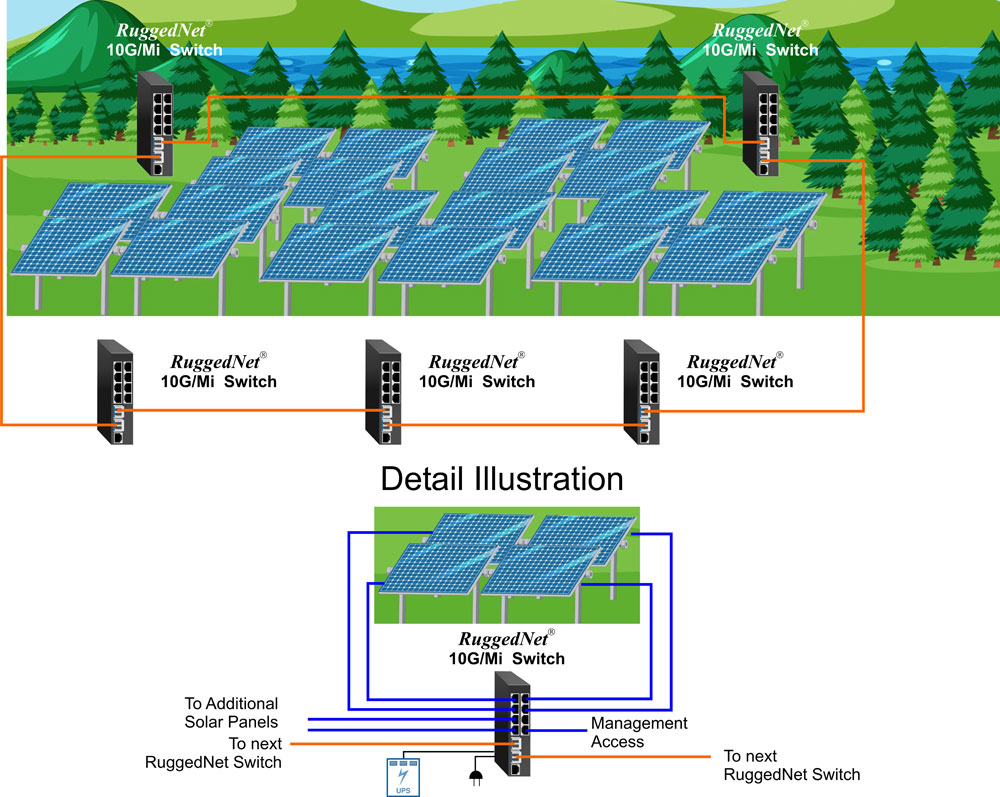
Key Architectural Elements
Fiber-Based Ring Topology
The network was designed as a closed-loop fiber ring, allowing data to flow in both directions. In the event of a fiber break or node failure, traffic is automatically rerouted, maintaining network connectivity.
From an engineering standpoint, this approach provides:
- Elimination of single points of failure
- Deterministic recovery behavior
- Predictable failover performance
Media Redundancy Protocol (MRP)
The RuggedNet switches support MRP, an industry-standard ring protection protocol designed for industrial Ethernet environments. MRP enables rapid detection of link failures and fast network reconfiguration—critical for maintaining real-time data flows.
Unlike traditional spanning tree mechanisms designed for enterprise LANs, MRP is optimized for ring topologies commonly used in industrial and utility networks.
Flexible Fiber and Copper Connectivity
Each RuggedNet switch includes Small Form Pluggable (SFP) ports supporting:
- 1G and 10G fiber transceivers
- 10/100/1000BASE-T and 10GBASE-T copper interfaces
This flexibility allowed the network to integrate field devices, controllers, and surveillance systems while maintaining high-speed fiber links between aggregation points.
Dual DC Power Inputs
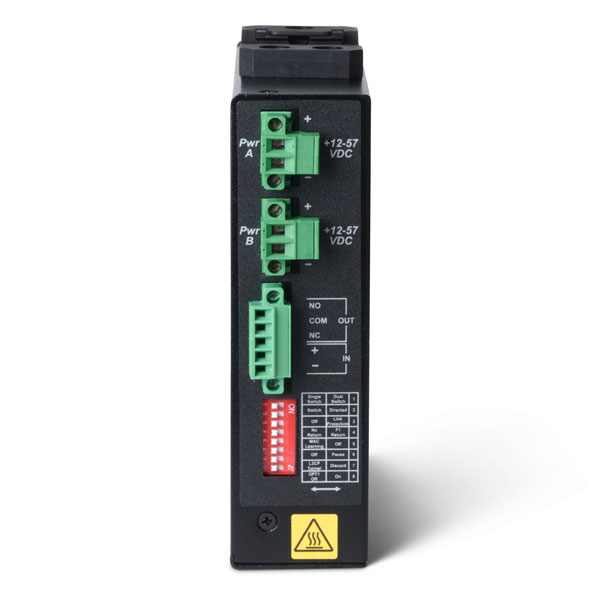
In utility-scale solar deployments, power anomalies are not hypothetical—they are expected. Each RuggedNet switch includes dual DC power inputs, enabling continuous operation if one power source fails.
From a reliability perspective, this design significantly reduces downtime caused by localized power issues and supports high-availability network operation.
Industrial-Grade Environmental Design
The switches are temperature-hardened and designed for outdoor installations, ensuring reliable operation in the extreme heat and environmental conditions typical of solar farms.
Implementation & Deployment Insights
Real-World Installation Considerations
During implementation, several practical factors influenced the final network design:
- Fiber routing across large outdoor areas, requiring careful planning to minimize exposure and maintenance risk
- Switch placement near inverters and monitoring equipment, reducing copper run lengths
- Power redundancy planning, aligning network equipment with available DC power sources
Industrial-grade hardware simplified deployment by eliminating the need for external enclosures or environmental conditioning in many locations.
Network Management and Visibility
The RuggedNet switches support a comprehensive set of management interfaces, including:
- Web-based management
- Telnet and SSH access
- SNMP v1/v2c/v3
- Serial console access
- Full IPv4 and IPv6 support
From an operational standpoint, this allowed the solar operator to integrate the network into existing monitoring systems while maintaining secure, role-based access for ongoing management.
Lessons Learned from the Field
In deployments like this, one of the most common mistakes is underestimating the long-term operational demands of the network. By selecting switches designed for industrial environments from the outset, the operator avoided:
- Premature hardware failures
- Unplanned maintenance outages
- Costly retrofits as the site scaled
Results & Business Impact
The completed deployment delivered a fault-tolerant, high-speed fiber ring network that met all operational requirements of the solar farm.
Key Outcomes
- Continuous real-time transmission of operational and surveillance data
- Improved system uptime, even during link or power failures
- High-speed Ethernet connectivity over long distances using fiber optics
- Resilient network operation through MRP-based redundancy
By maintaining uninterrupted communication between field devices and the central control system, the operator improved both energy production efficiency and site security visibility.
Importantly, these results were achieved without overengineering the network or introducing unnecessary complexity—an outcome that reflects thoughtful design and appropriate technology selection.
Why This Approach Works for Similar Use Cases
While this case focuses on a solar farm, the underlying design principles apply broadly across:
- Wind farms and renewable energy facilities
- Transportation and smart infrastructure
- Industrial automation and control networks
- Government and utility installations
- Large outdoor surveillance systems
Any environment requiring long-distance Ethernet, high availability, and industrial reliability can benefit from a fiber ring architecture built on RuggedNet industrial switches.
Omnitron’s design philosophy—combining standards-based networking, industrial durability, and flexible deployment options—aligns well with the real-world demands of these applications.
Engineering Takeaway
From an engineering perspective, resilient networking is not about adding complexity—it’s about eliminating failure modes. Fiber ring topologies, paired with industrial-grade switching and proper redundancy protocols, provide a proven path to reliable operation in demanding environments.
Conclusion
This solar farm deployment demonstrates how Omnitron RuggedNet 10G managed industrial Ethernet switches enable the creation of resilient, fault-tolerant fiber ring networks capable of supporting mission-critical renewable energy operations.
By combining high-speed fiber connectivity, MRP-based redundancy, dual power inputs, and industrial-grade design, the solution delivered reliable communication across a challenging outdoor environment.
Backed by U.S.-based manufacturing and compliance with TAA, BAA, and NDAA requirements, Omnitron continues to serve as a trusted infrastructure partner for organizations building networks where reliability is non-negotiable.
